
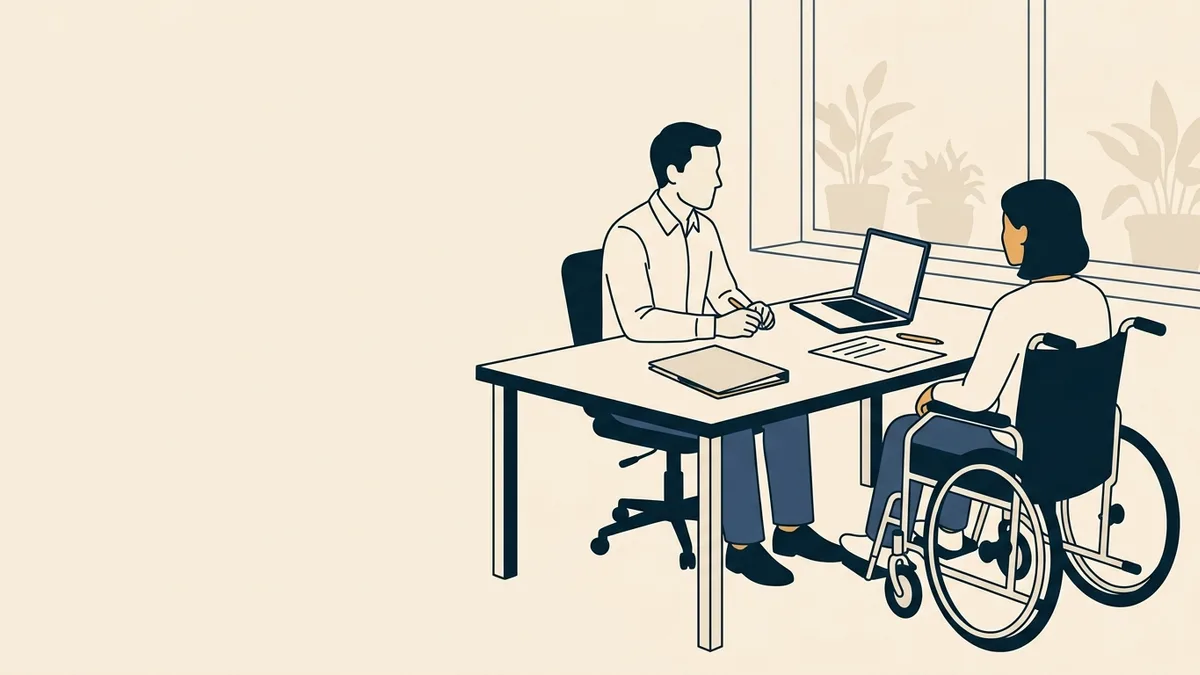
The CRC is a national certification, not a license. Rehabilitation counselors who provide counseling usually need a state license, most often the LPC. Louisiana, Massachusetts and New Jersey issue separate rehabilitation counselor licenses, and CRCC lists 13 jurisdictions that accept the CRC exam toward general counseling licensure by rule or policy.
The Certified Rehabilitation Counselor (CRC) credential, issued by the Commission on Rehabilitation Counselor Certification (CRCC), is held by more than 13,000 counselors: CRCC reported 13,127 active CRCs as of January 14, 2025. It is a respected national certification. It is not, by itself, a state license to practice counseling.
Whether you need a license depends on what you do. Vocational and job-placement roles in some settings may not require one. Providing counseling to clients usually does.
Which states have a separate rehabilitation counselor license?
CRCC identifies three: Louisiana, Massachusetts and New Jersey. Massachusetts, for example, licenses rehabilitation counselors (LRC) under its own regulation, 262 CMR 4.00, which uses the CRCC certification exam as the licensing exam. The CRC itself is not required for the Massachusetts license, only the exam.
Where does the CRC exam count toward the LPC?
CRCC's advocacy page lists states that recognize the CRC exam for general counseling licensure. By rule or regulation: Arizona, the District of Columbia, Illinois, Michigan, North Carolina, Oregon, Pennsylvania, Tennessee, West Virginia, Wisconsin and Wyoming. By departmental policy: Alaska and Minnesota. CRCC adds that other states may consider the exam case by case.
North Carolina's board, for example, lists the CRC exam alongside the NCE and NCMHCE as acceptable for the LCMHC. Arizona's board accepts it for the LPC as well.
That matters for portability. A CRC who took only the CRC exam may find it satisfies one state's exam requirement and not another's. Before moving, check the target state's rule. If it is one of the NCMHCE-only states, such as New York, the CRC exam will not substitute. See the states that require the NCMHCE.
Does the compact help rehabilitation counselors?
Only through an LPC. The Counseling Compact covers licensed professional counselors. A CRC who also holds an eligible independent counseling license in a live home state can use privileges for that license. A separate rehabilitation counselor license, like Massachusetts's LRC, is not part of the compact, and Massachusetts is not a member in any case.
Keeping both
CRCC requires renewal every five years with 100 clock hours of CE in each cycle, including ethics content. State licenses run on their own, usually shorter, cycles. The same courses can often count toward both if the providers are acceptable to each. Our CE across multiple licenses post covers how to plan that.
For a CRC moving states, the work is usually the state counseling license, plus the separate rehabilitation license where one exists. Our License by Endorsement and Full State License Application services cover both, and the Annual Renewal and CE Compliance service can track the CRC cycle next to your state renewals.
Common questions
- Can I use my CRC exam to get an LPC?
- In some states. CRCC lists Arizona, DC, Illinois, Michigan, North Carolina, Oregon, Pennsylvania, Tennessee, West Virginia, Wisconsin and Wyoming by rule, and Alaska and Minnesota by policy. Others may consider it case by case.
- Does Massachusetts require the CRC for its rehabilitation counselor license?
- No. Massachusetts uses the CRCC certification exam as its licensing exam, but holding the CRC credential itself is not required for the license.
- How often does the CRC renew?
- Every five years, with 100 clock hours of continuing education in each cycle, including ethics content, according to CRCC.
Need Help with Your Application?
We handle the counselor licensing process end-to-end — eligibility screening, documents, board follow-ups, and tracking.