
A non-CACREP degree usually matters only when a second state reviews your transcript. North Carolina requires CACREP for applicants after July 1, 2022, and Florida requires CACREP, MPCAC or equivalent accreditation from July 1, 2025 on its exam route. Years-of-practice endorsement routes and live compact privileges are how most experienced counselors get around it.
Plenty of excellent counselors trained in programs that were never accredited by CACREP, the Council for Accreditation of Counseling and Related Educational Programs. Some programs were accredited by a different body, some were housed in psychology departments, and some simply predated the push toward accreditation. In the state where you were first licensed, none of this mattered, because the board approved your degree when it licensed you.
It starts to matter when you apply somewhere else. A new board looks at your degree fresh, against its own rules, and some of those rules name CACREP.
Where is CACREP written into the rules?
A few examples we have confirmed against the state's own text:
- North Carolina. For LCMHC applicants after July 1, 2022, the board requires a master's degree of at least 60 semester hours from a CACREP-accredited program.
- Florida. Beginning July 1, 2025, the statute requires LMHC applicants on the exam route to hold a master's of at least 60 semester hours from a program accredited by CACREP, the Masters in Psychology and Counseling Accreditation Council (MPCAC), or an equivalent accrediting body. Florida's endorsement route for counselors already licensed elsewhere is a separate path built around active practice.
- New Jersey. Its endorsement rule accepts a CACREP program of at least 60 semester hours, or a non-CACREP program that meets the hour requirement plus specific content areas. A non-CACREP degree is reviewed area by area.
- New York. If your program was not registered with New York or accredited by CACREP, the state evaluates your transcript individually and needs a certification of your supervised internship and practicum on its own form.
Ohio was the first state to tie licensure to CACREP for its own programs, starting in 2018. Other states have discussed similar moves. Rules in this area change, so treat any list, including this one, as a starting point and read the current rule for your target state.
What about the 60-hour standard?
A separate problem travels with accreditation: degree length. Many older counseling degrees were 48 semester hours. Newer rules increasingly ask for 60. Texas, for example, requires 60 graduate semester hours for programs begun on or after August 1, 2017 and 48 for programs begun before then. California's Path B requires a 60-unit total for degrees begun on or after August 1, 2012 or completed after December 31, 2018, and lets you make up as many as 12 semester units after the fact.
The Counseling Compact also sets a 60-hour floor, but at the state level: a state must require a 60-hour counseling degree or 60 hours of graduate coursework in designated areas to join. Your eligibility for a privilege rests on your home-state license, which is one reason the compact helps counselors with older degrees. If your home state licensed you, the remote state does not re-review your transcript.
How do experienced counselors get through?
Most non-CACREP counselors who move do eventually get licensed. The routes:
- Use a years-of-practice endorsement route. Many endorsement statutes care less about your degree once you have practiced long enough. New York's endorsement route, for instance, rests on five years of licensed practice in the prior ten. California's Path A asks for two years of independent licensure and a degree from an accredited institution, without a CACREP test. Virginia's endorsement rule, amended in July 2026, asks for a graduate degree transcript and a license that allows independent practice, with no accreditation requirement in the rule.
- Use the compact where it is live. If both your home state and the target state are issuing privileges, the degree question largely disappears.
- Remediate specific gaps. Where a state reviews content areas, a missing course can usually be taken at a graduate level from an accredited school. Boards specify whether continuing education counts, and for degree content it usually does not.
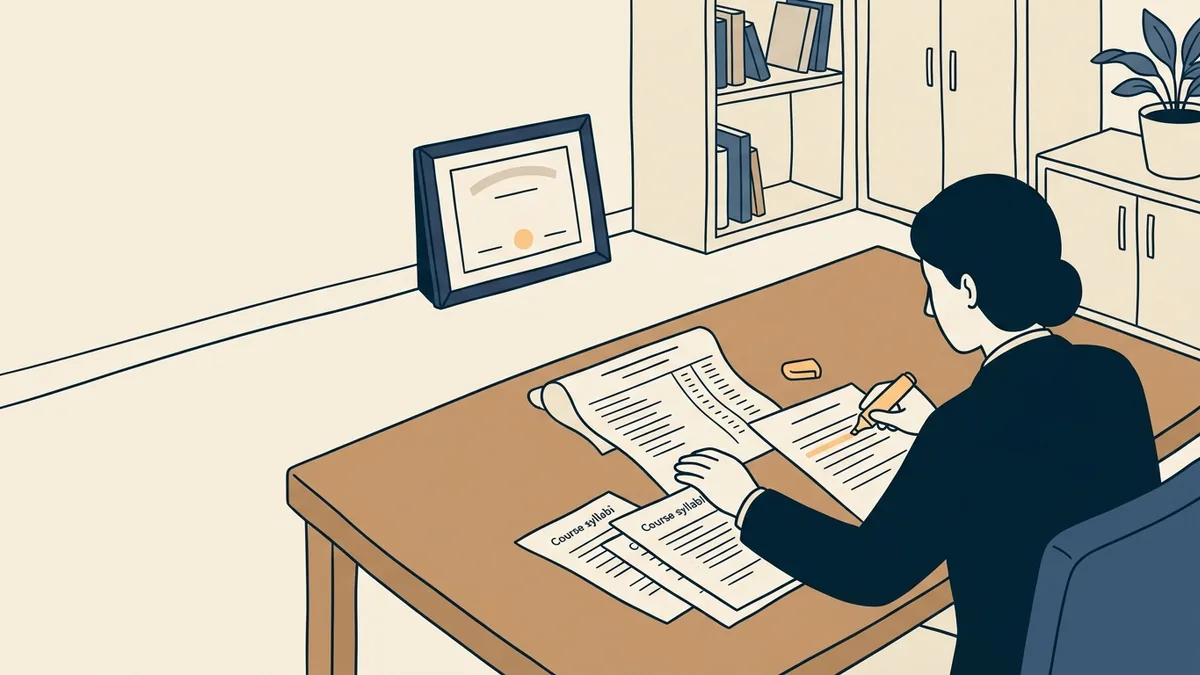
- Bring syllabi, not just transcripts. A course titled "Counseling Seminar II" tells a reviewer nothing. A syllabus showing the content does.
Where is it genuinely hard?
The hard cases are states that require CACREP outright for new applicants and offer no years-of-practice escape for an experienced out-of-state licensee, or states that review content areas strictly and count only graduate-level coursework. That combination can mean taking several graduate courses at a point in your career when it feels absurd. It is still usually cheaper than a second degree, which is what a few counselors assume they need and almost never do.
If you have a non-CACREP degree and a target state in mind, our coursework review post walks through how boards read a transcript. When the answer is unclear, a Counseling Compact Readiness Review or a conversation through our contact form will usually tell you which route is shortest before you pay any board fee.
Common questions
- Can I get licensed in North Carolina without a CACREP degree?
- For LCMHC applicants after July 1, 2022, the board requires a 60-semester-hour CACREP degree. If you already hold a license elsewhere, check North Carolina's reciprocity and endorsement pathways, which have their own requirements, before assuming the degree rule ends the conversation.
- Does the counseling compact care if my degree is CACREP?
- Not directly. A state must require a 60-hour degree or equivalent coursework to join, but your privilege is based on your home-state license. The remote state does not re-review your transcript.
- Is my 48-credit counseling degree going to be a problem?
- It can be in states that now require 60 hours for newer degrees. Some, like California on Path B, let you remediate up to a set number of units with graduate coursework. Others look at when your program began.
Need Help with Your Application?
We handle the counselor licensing process end-to-end — eligibility screening, documents, board follow-ups, and tracking.