
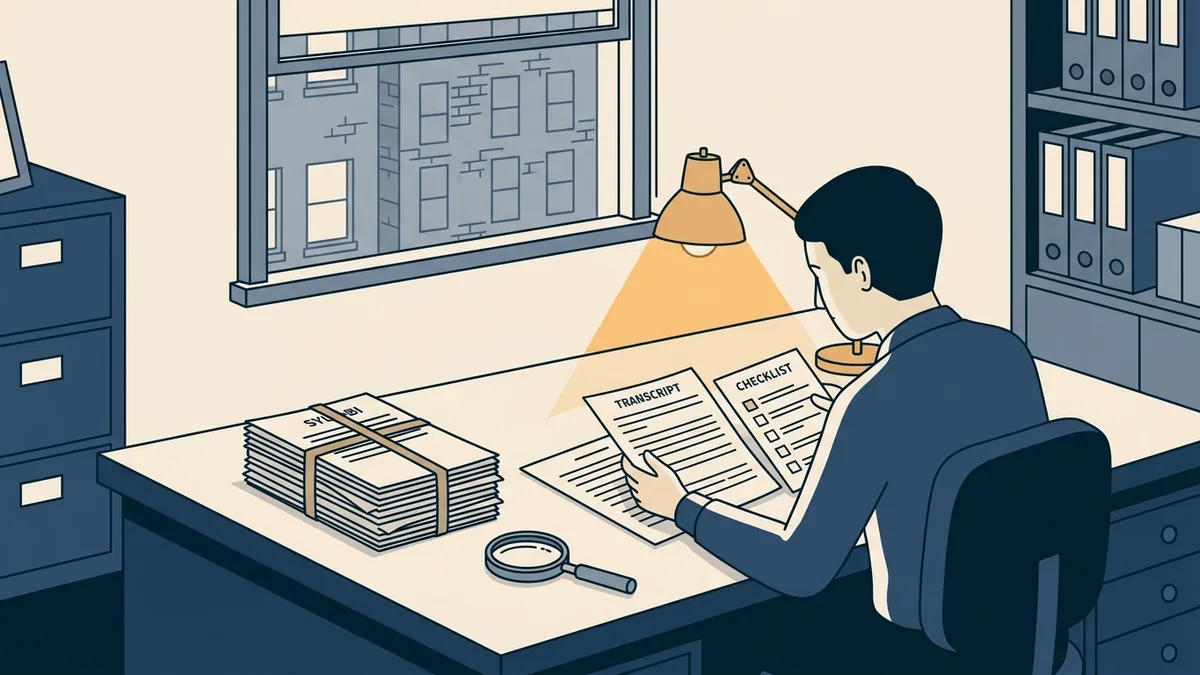
A board reviewer matches your transcript against the state's required content areas and credit hours, and flags anything missing. Texas, New York and California each use different lists. Send syllabi for vaguely titled courses, fix gaps with graduate coursework from an accredited school, and check whether a years-of-practice endorsement route or a compact privilege avoids the review.
When you apply for a counseling license in a new state, someone at the board sits down with your transcript and a list. The list is the state's required content areas. The reviewer's job is to find each area somewhere on your transcript, check the credit hours, and mark anything missing as a deficiency. It is a clerical exercise more than a judgment of your clinical skill, and it rewards applicants who make the matching easy.
What lists are they checking against?
Every state writes its own. Three examples show how much they vary.
Texas
Texas Rule 681.83 lists the academic areas for an LPC: normal human growth and development, abnormal human behavior, appraisal or assessment techniques, counseling theories, counseling methods or techniques, research, lifestyle and career development, social, cultural and family issues, professional orientation, and a practicum of at least 300 clock hours with at least 100 hours of direct client counseling. The degree must total 60 graduate semester hours for programs begun on or after August 1, 2017, or 48 for earlier programs. Texas lets the hours come from the degree itself, from additional graduate coursework, or a mix. Texas offers no endorsement shortcut, so every out-of-state applicant goes through this review. See our Texas guide.
New York
New York requires a counseling degree of at least 60 semester hours with content in human growth and development, social and cultural foundations, counseling theory and practice, psychopathology, group dynamics, lifestyle and career development, assessment and appraisal, research and program evaluation, professional orientation and ethics, and foundations of mental health counseling and consultation, plus a supervised internship or practicum of at least one year and 600 clock hours. If your program was not registered with New York or accredited by CACREP, the state evaluates you individually and needs a Certification of Supervised Internship and Practicum (Form 2INT) from your school. Counselors with five years of licensed practice in the prior ten can use endorsement instead. See New York LMHC by endorsement.
California
California's Path B review is the most granular. It counts 13 core content areas and requires that at least 7 of them, including assessment and diagnosis, sit fully inside your degree or the degree cannot qualify at all. Missing areas, a unit total under 60 for newer degrees, and up to 15 semester units of advanced coursework can be made up through graduate courses from an accredited or approved school. Continuing education does not count for those. The board's out-of-state guide also warns that it may ask for syllabi. California's Path A, for counselors with two years of independent licensure, skips this review and asks instead for four California-specific courses.
What can a reviewer actually see?
Only what is on paper. A reviewer sees course titles and credit hours on a transcript. If a course called "Clinical Practice III" covered psychopathology, the reviewer has no way to know that unless you show it. The fix is simple and almost nobody does it up front:
- Pull the syllabus for every course you are counting toward a required area, especially courses with vague titles.
- Build a one-page crosswalk: required area, your course number and title, credit hours, and which syllabus page shows the content.
- If your program has closed or merged, contact the successor institution or the state agency that holds closed-school records early. Syllabi from a decade ago can take time to locate.
Some states will not accept a crosswalk you write yourself, and some do not ask for syllabi unless they find a gap. Having them ready costs a few hours. Not having them, when asked, costs weeks.
How do you fix a deficiency?
- Read the deficiency letter literally. It will name the content area and often the minimum credit. Take exactly that.
- Confirm the provider before enrolling. Most states require graduate-level coursework from a regionally or nationally accredited institution for degree content, and will reject continuing education for it. California, for example, accepts CE only for its California-specific law and ethics and additional coursework items.
- Ask whether one course can cover two gaps. California allows a course that remediates a core content area to also count toward an additional coursework item, but not toward advanced coursework. Other states have their own double-counting rules.
- Send the new transcript straight from the school, and keep the application open. Many states hold an application open for a limited period, so check yours.
When is a coursework review worth avoiding altogether?
If both your home state and the target state issue Counseling Compact privileges, a privilege avoids the transcript review, because the remote state relies on your home-state license. If the target state has a years-of-practice endorsement route, that route often skips the content-area review. Check both before you order a single transcript.
Our License by Endorsement and Full State License Application services include building the crosswalk and assembling syllabi before submission, so the reviewer can match your courses without guessing. If you want to know first whether a review is even necessary, ask us.
Common questions
- Can I use CE courses to fix a coursework deficiency?
- Usually not for degree content. Most states require graduate-level courses from an accredited school. California, for example, rejects CE for core content areas and advanced coursework, but accepts approved CE providers for its California-specific law and ethics and additional coursework items.
- What is Form 2INT for New York?
- It is New York's Certification of Supervised Internship and Practicum. If your counseling program was not registered with New York or CACREP-accredited, your school completes it so the state can confirm your supervised internship during its individual education evaluation.
- Should I send syllabi even if the board doesn't ask?
- Have them ready either way. Reviewers only see course titles and hours, so a vague title can read as a gap. Some boards request syllabi only after they find a problem; being able to send them the same day saves weeks.
Need Help with Your Application?
We handle the counselor licensing process end-to-end — eligibility screening, documents, board follow-ups, and tracking.