
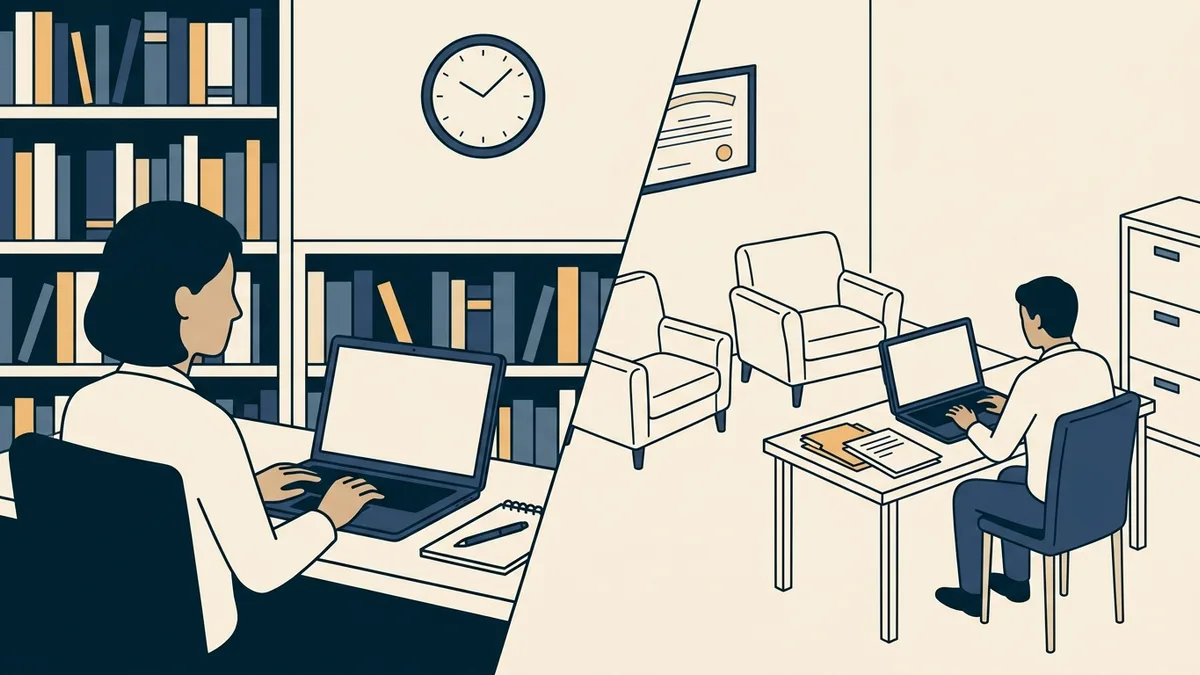
In the states we checked, real-time video supervision counts toward associate counselor hours, with conditions: Florida requires at least half in person, California requires the supervisor to document that video is appropriate, and phone or chat generally does not count. An out-of-state supervisor must also qualify under your state's supervisor rules.
Supervision moved to video in 2020 and largely stayed there. The rules caught up at different speeds, and they did not all land in the same place. If your supervisor is across town, the question is just whether video counts. If your supervisor is across a state line, there is a second question: whether that person can supervise you at all under your state's rules. This post takes them in that order.
Does video supervision count toward your hours?
In every state we checked against its own rules in October 2026, yes, with conditions. None of them set a percentage cap on video supervision. Florida instead sets a minimum for in-person supervision, which comes to the same thing.
Florida (Registered Mental Health Counselor Interns)
Rule 64B4-2.002 allows supervision by electronic means but requires that at least 50 percent of supervision interactions be in person and face to face, that at least one in-person meeting happen before any online supervision, and that group supervision be in person. The supervisor and intern are responsible for client confidentiality. The rule includes an exception allowing all supervision electronically, including by phone, when the supervisor judges it necessary for health, safety or welfare.
California (Associate Professional Clinical Counselors)
Business and Professions Code §4999.46.2 treats two-way, real-time videoconferencing as face-to-face supervision. Within 60 days of starting, the supervisor must assess and document whether video supervision is appropriate for the associate, and the supervisor is responsible for confidentiality under state and federal law.
New York (LMHC limited permit holders)
8 NYCRR §79-9.3 says "face-to-face supervision may utilize technology acceptable to the Department, including secure video conferencing to protect confidentiality." No cap is stated.
Virginia (Residents in Counseling)
18VAC115-20-52, as amended effective December 18, 2025, allows supervision by "secured technology that maintains client confidentiality and provides real-time, visual contact."
North Carolina (LCMHC Associates)
21 NCAC 53 .0212: "Video supervision is permitted as long as the session is synchronous and involves verbal and visual interaction," and it must protect confidentiality consistent with the ACA Code of Ethics.
Pennsylvania
The regulation itself (49 Pa. Code §49.13) refers to supervision "in person." A board statement of policy published on pa.gov treats a HIPAA-compliant platform with synchronous audio and video as meeting the in-person requirement and excludes phone, email and chat. We could not confirm that document's final adoption status, so get the board's answer in writing before relying on video for Pennsylvania hours.
Notice the common thread. Real-time video with both audio and picture is accepted; phone calls, chat and recorded messages generally are not. Every rule we read puts confidentiality on the supervisor and associate, and Pennsylvania's policy statement says sessions must be held from professional, secure locations, which rules out supervision from a coffee shop.
What changes when the supervisor is in another state?
The supervision rules of the state where you are practicing govern. That state decides who qualifies as your supervisor, and some states require their own credential:
- Texas requires a Council-approved LPC-S for internships physically in Texas (22 TAC §§681.92–681.93). An out-of-state supervisor, however qualified at home, does not fit.
- Virginia requires the supervisor to be licensed as an LPC or MFT "in the jurisdiction where the supervision is being provided," with post-licensure experience and supervision training.
- Florida lets a supervisor licensed as a mental health counselor in another state qualify if they meet Florida's LMHC standards, but supervision provided in Florida carries additional supervisor training requirements (Rule 64B4-31.007).
- North Carolina accepts an "equivalently and actively licensed" supervisor who meets its training and experience standards, without requiring a North Carolina license.
More detail, including how hours earned in one state transfer to another, is in supervisor licensed in another state.
A setup that survives a board audit
- A written supervision agreement naming the platform, how confidentiality is protected, and how often you will meet in person if your state requires it.
- A log that records the format of each session (individual, triadic, group; in person or video) alongside the date and length.
- In California, the supervisor's documented assessment that video is appropriate.
- In Florida, a running count of in-person versus electronic interactions so you never fall below half.
- For an out-of-state supervisor, the board's written confirmation that they qualify, plus their license verification.
Hours lost to a format problem are usually discovered at the upgrade application, when it is too late to redo them. If you want the rule for your state checked before you start, that is part of our Associate-to-Independent License Upgrade service; see pricing.
Common questions
- Does video supervision count toward my LPC hours?
- In the states we checked, yes, if it is real-time with audio and video and protects confidentiality. Florida requires at least half of supervision interactions in person. Check your own board's rule.
- Can my supervisor in another state supervise me by Zoom?
- Only if your state accepts them as a supervisor. Texas requires an LPC-S for internships in Texas, and Virginia requires a supervisor licensed where the supervision is provided. Others accept equivalent out-of-state licenses.
- Do phone calls with my supervisor count as supervision?
- Generally not. The rules we read require synchronous visual contact. Florida's rule has a narrow exception allowing electronic supervision, including phone, when the supervisor judges it necessary for health, safety or welfare.
Need Help with Your Application?
We handle the counselor licensing process end-to-end — eligibility screening, documents, board follow-ups, and tracking.